Dental Implants
Your dental implant specialists will see you now.
A dental implant is a titanium component placed into the jawbone to replace the root of a missing tooth. Once integrated with the bone, the implant provides a stable foundation for a crown, bridge, or denture. Implants are designed to restore function and appearance while supporting long-term oral health and surrounding structures.
Performed by
Oral & Maxillofacial Surgeon (OMS)
Periodontist
Consultations Available at
Appointment type
Costs
Consultation fee:
$195
Procedure:
$3,200
Grafting fee (if needed)
VF
Hospital fee:
VF
VF – Variable Fees; exact costs are given after clinical assessment. Prices are indicative only; final fees will be confirmed after your consultation.
Understanding dental implants
Problems associated with missing teeth.
Missing teeth can affect chewing function, placing uneven load on remaining teeth and altering the bite over time. Gaps may also allow neighbouring teeth to shift, which can complicate chewing and make oral hygiene more difficult.
Beyond function, tooth loss can contribute to gradual bone loss in the jaw where teeth are no longer present. This change in structure may affect facial support, particularly if multiple teeth are missing or the space remains untreated for an extended period.

Common Symptoms & Concerns
When it may be time for dental implants.
Missing one or more teeth
A gap can affect how your bite functions and how surrounding teeth are supported.
Loose or failing teeth
Teeth weakened by decay or damage may no longer provide stable function.
Difficulty chewing on one side
Uneven chewing may place extra load on remaining teeth and jaw joints.
Changes in bite after tooth loss
Loss of a tooth can alter how upper and lower teeth meet.
Adjacent teeth shifting into a gap
Over time, nearby teeth can drift, affecting alignment and bite balance.
Poor fit with dentures or bridges
Unstable dentures may indicate reduced support from underlying bone.
What to expect during specialist treatment.
Step 1
Consultation
We examine your teeth, bite, gum health and jawbone structure to assess the options available.
Step 2
Imaging and Scanning
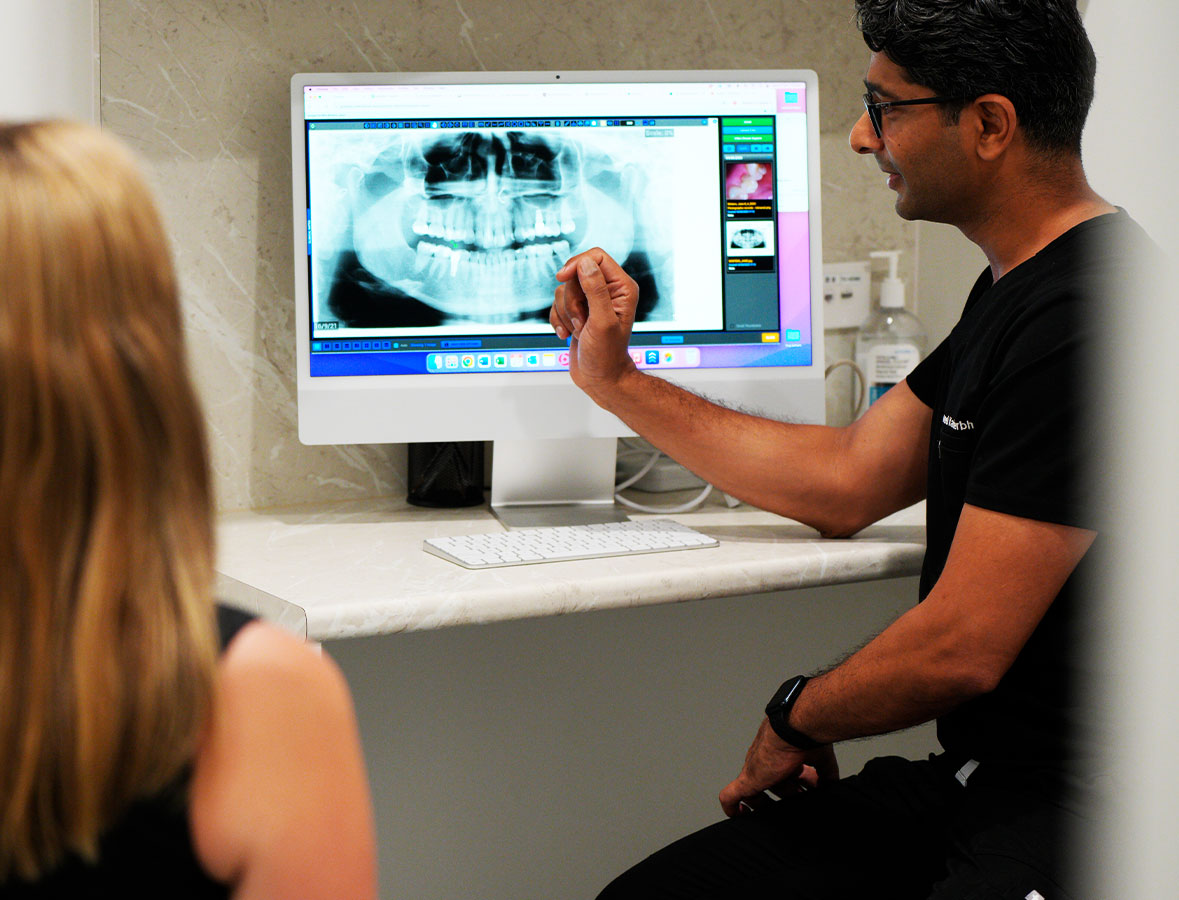
A 3D X-Ray and digital intra-oral scan are taken to match your bite to the underlying bone structure.
Using specialised software, a virtual model of your anatomical structures is used to plan a very precise position and angle of your dental implant
Step 3
Surgery
Using a 3D printed surgical guide, the implant is placed under local anaesthetic, IV sedation, or general anaesthetic. Sometimes bone or soft tissue grafting will also be carried out during this surgery.
Step 4
Review
After a period of healing, an osseointegration check is carried out to ensure that the implant has fused to the bone.
Step 5
Restoration
You return to see your dentist or prosthodontist for for fabrication of the crown, bridge or denture to fit onto the implant.
Why implants may help
Dental implants can help restore chewing function and cosmetics, with a fixed replacement for missing teeth. For some patients, this may help avoid alternative replacement options, such as dentures.
- Improve chewing stability and comfort
- Support jawbone structure over time
- Provide a fixed tooth replacement option
- Improve function compared with removable alternatives

Our OMS and Periodontal Specialists
AHPRA# MED0001859185 // DEN0001411574

AHPRA# MED0001665517 // DEN0001073123
AHPRA# MED0001665517 // DEN0001073123

AHPRA# DEN0001411578

AHPRA# DEN0000988601

AHPRA# DEN0000968658

AHPRA# MED0001201650 // DEN0002232766

AHPRA# DEN0001591048

AHPRA# MED0002309075 // DEN0002295324

AHPRA# MED0001931982 // DEN0000972483
AHPRA# DEN0001858283
Frequently asked questions
Can’t find the right answer to your question? See all FAQs or get in touch with one of our team members, and they can assist you with any enquires.


BOOK ONLINE
Book now for specialist care.
Book an appointment with a specialist at a convenient time and clinic, using our secure and easy booking platform.
FOR DENTISTS
Refer a Patient
Focus builds upon your own clinical excellence with expert care and great patient experience.

Safe, specialist management of facial skin cancer. We focus on assessment and reconstruction where required.

Safe, specialist care to rebuild bone where lost or insufficient. We focus on restoring structure and long-term stability.

Safe, specialist management of head and neck pathology and reconstruction. We focus on restoring function and stability.
Safe, specialist management of facial injuries. We focus on restoring function, alignment, and structural stability.

Safe, specialist care for issues related to jaw alignment, which can affect speech, chewing, and facial balance.

Safe, specialist care for impacted or painful wisdom teeth. We focus on clarity, comfort, and long-term oral health.